Feeling fine can still hide slow-building risks
The day you finally book a checkup is often the day nothing dramatic is happening. You’re getting through meetings, carrying groceries, answering texts, and the only “symptom” is that you’re a little more tired than you used to be—so you blame the calendar. Many slow-building health shifts don’t announce themselves with pain or a clear moment of change. Blood pressure can climb without making you feel different. Blood sugar and cholesterol can drift in the background. Weight can settle upward in small, forgettable increments. Even sleep debt and chronic stress can start to feel like your normal setting.
That’s where “I feel fine” can be misleading. When life is busy, you adapt—more coffee, less movement, later nights—and your body often adapts right along with you, at least for a while. Without occasional measurements, it’s easy to accept a new baseline that’s quietly worse than your old one, and only notice when the gap finally becomes hard to ignore.
Checkups create a baseline your future can be compared to
You might notice it in a small, annoying way first: your watch says you’re sleeping seven hours, but you wake up feeling like you negotiated with the snooze button all night. Or your jeans fit the same, yet climbing a couple flights of stairs feels more “present” than it used to. In day-to-day life, those signals are easy to wave off because they’re inconsistent. Some weeks are smoother, some are chaos, and your memory of how you “usually” feel is shaped by the last few busy months.
A checkup turns that fuzzy self-assessment into a reference point. A blood pressure number, a weight trend, a cholesterol panel, an A1C—none of these is meaningful only because of today. They matter because they become your comparison later, when you’re tempted to chalk changes up to age, stress, or a rough season. The limitation is that one visit can still be a snapshot: a rushed morning, extra caffeine, poor sleep, or nerves can skew it. But repeated snapshots, spaced over time, start to show whether “fine” is holding steady or quietly drifting.
Prevention works by catching patterns, not emergencies
It can feel almost silly to talk about prevention when the visit starts with, “So, how have you been?” and your best answer is basically, “Busy.” The strange part is that emergencies rarely begin as emergencies. They often start as a set of numbers that are a little off, then a little more off, while you’re still packing lunches and making deadlines. A single high blood pressure reading might be nerves and parking-lot stress. A slightly higher A1C might be a holiday stretch that never fully ended. On their own, those blips are easy to dismiss.
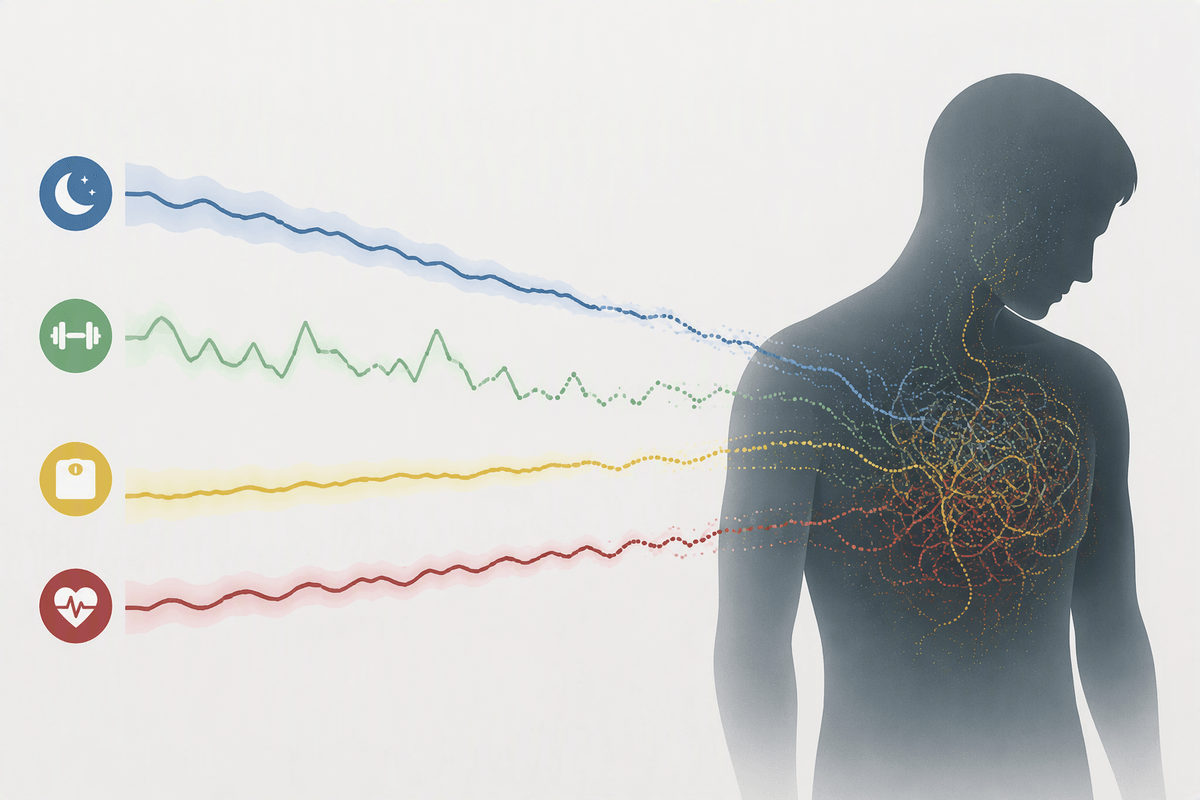
Prevention is the slower, less dramatic work of noticing when the “blips” line up. When weight creeps up at the same time sleep gets shorter, workouts get sporadic, and your resting heart rate edges higher, that pattern can matter more than any one symptom. The patterns can be messy: travel weeks, illness, new meds, a rough quarter at work. But seeing the drift early gives you room to respond while things are still flexible, instead of waiting for your body to force the issue.
Screening tests reduce uncertainty when they fit your risk
Sometimes the most stressful part of a “routine” visit is the moment a test gets mentioned and you realize you don’t know if it’s overkill or overdue. A friend your age just had a colonoscopy. Someone else swears by full-body scans. Meanwhile, you’re sitting there thinking, I feel fine, and also thinking about the time, the copay, and what it would mean to find something you weren’t looking for.
Screening works best when it matches your actual risk and reduces a specific kind of uncertainty. A blood pressure cuff, a cholesterol panel, an A1C, certain cancer screenings—these aren’t “more information” in the abstract; they’re a way to check whether the quiet drift you can’t feel is happening anyway. The limitation is that testing isn’t neutral: the wrong test at the wrong time can create confusing results, follow-up appointments, and a new layer of worry. When the fit is right, though, the numbers don’t just label you—they clarify whether “fine” is stable or just familiar.
Small risk factors stack up through everyday trade-offs

It’s often in the “small choices” you don’t even remember making. You take the elevator because you’re carrying a bag. You eat something salty because it’s fast. You fall asleep on the couch and count it as rest, then wake up and scroll for a few minutes that turns into an hour. None of it feels like a problem. The misunderstanding is thinking risk only comes from big, obvious habits, when it’s more often built from tiny trade-offs that repeat under stress.
Over time, those trade-offs can line up in ways that are hard to feel but easy to measure. Slightly less sleep can nudge cravings and patience, which shifts food and movement, which can move weight, blood pressure, and blood sugar a little at a time. Extra caffeine, more sitting, and “good enough” dinners can keep you functioning while your numbers drift. The drift isn’t consistent—vacation resets you, a busy month knocks you back—so it’s easy to believe nothing is really changing until your baseline has already moved.
Incidental findings can confuse even careful planners
It may start with a portal alert you weren’t expecting: a lab value flagged just barely “high,” a note about a “small cyst,” a “nodule,” or “borderline” something that wasn’t the reason you came in. You can do everything right—show up fasting, fill out the forms, ask good questions—and still walk out with more uncertainty than you arrived with. The confusing part is that incidental findings often sound urgent in writing, even when they’re common and not clearly meaningful.
What makes these results so disruptive is that they interrupt the simple story of “fine.” One unexpected detail can pull focus away from the slow trends that matter more: your blood pressure over a year, your A1C over two, your weight and sleep over a season. Follow-up can take time—repeat labs, an ultrasound, a second opinion—while your mind treats the finding like an emergency. In that gap, it helps to remember that a lot of prevention is sorting signal from noise, not collecting surprises.
A good checkup is coordination, not just a checklist
Halfway through the visit, it’s easy to realize you’ve been answering questions without actually describing your life. You mention “stress” and “sleep,” but the details stay vague, and the conversation drifts back to a list: vitals, labs, refills, next year. That’s the quiet failure mode of a checkup—it becomes a set of boxes that get checked while the real patterns stay scattered across portals, urgent-care notes, old specialists, and whatever you can remember in the room.
A more useful checkup often feels less like a single appointment and more like someone tying threads together. Your clinician can notice that a slightly higher blood pressure makes more sense next to weight creep, snoring, a new shift schedule, or a medication change. The limitation is that coordination takes effort: records don’t always arrive, symptoms don’t line up neatly, and you might leave with a “watch and recheck” plan that feels unsatisfying. Still, that kind of plan is often the point—keeping “fine” from quietly becoming your new normal.