Spotting the difference between mobility and stability
You notice it most on the first few stairs: the hip feels “tight,” but what actually shows up is a little wobble—your knee drifts inward, your foot grabs the step, and your low back does the push to get you up. That’s often the moment people assume they need more stretching. Sometimes they do. But just as often, the range is already there and the problem is that the range doesn’t feel reliable when your body has to load it.
Mobility is how far the joint can go when things are relaxed; stability is whether you can control that motion when it counts. A simple clue is what happens at the edges: if you can pull your knee in or rotate your thigh when you’re sitting, but the same position feels shaky in a split squat or when stepping down, it may be less about “not enough flexibility” and more about endurance in the small stabilizers. It can feel the same—tight, guarded, inconsistent—until you watch where the effort shifts.
Why hips feel stiff even when they’re flexible
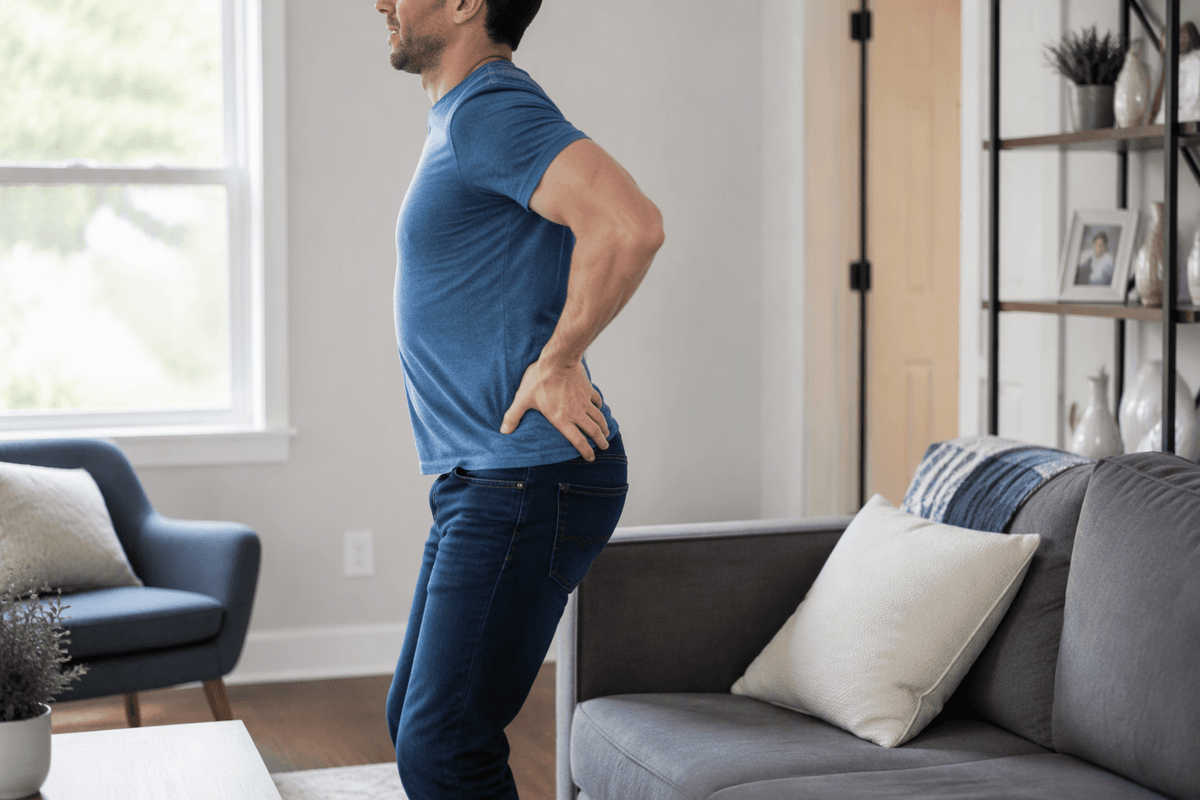
It can be confusing when you sit on the couch, pull your knee toward your chest, and it moves just fine—then you stand up and the front of the hip feels “stuck.” That mismatch often shows up after long sitting or after workouts where you repeat the same patterns. The hip isn’t necessarily short on range; it just doesn’t trust the range once your weight is on it.
When the deeper muscles around the hip tire easily, your body tends to add tension for security. That extra tone can feel like stiffness, even if the joint still has flexibility available. You’ll sometimes notice it as a pinchy sensation at the front when you take a longer stride, a knee that wants to collapse inward as you lower into a squat, or a low back that kicks in early to finish the movement. None of these are perfectly consistent day to day, which is part of why “tightness” can be such a misleading label.
Simple stability practice: slow control near end ranges
The giveaway is how the last bit of a motion feels. You drop into a squat and the first half is smooth, then the knees start hunting for a position and your feet grip the floor like they’re trying to create stability from the outside. In that moment, stretching the hip can feel urgent, but what’s missing is often slower control where you already have range.
A simple way to build that control is to spend a few seconds “owning” the edge of a comfortable position instead of bouncing past it. Think of a shallow split squat or a supported single-leg balance where you move into a slightly challenging hip angle, pause, and make tiny adjustments without letting the knee cave or the low back brace to help. It can feel oddly hard despite being low effort—shaky, inconsistent, and different on each side. That’s usually the point: you’re teaching the hip to stay organized near end range, not just visit it.
Mobility that lasts depends on breathing and tension
You’ll feel it when you try to “relax into” a hip position and, without meaning to, you hold your breath. The ribs get quiet, the jaw tightens, and suddenly the stretch feels more intense—but also less specific. For a lot of people who sit all day, that little brace is automatic. It can make the hip seem like it has a hard stop, when it’s really the rest of the body adding tension for stability.
When breathing stays shallow, the pelvis often stiffens and the low back wants to help, especially near the end of rotation. That’s why a hip can look mobile on a good day and feel blocked on a stressful or tired day. You can’t force your way around it; more effort usually adds more guarding. But if you can keep a slow exhale while you hold a controlled end-range position, the hip often feels “available” in a way that carries over when you stand up and load it.
The surprising downside of stretching harder or longer
It often happens at night: you sink deeper into a hip stretch because it finally feels like you’re “getting somewhere,” and for a few minutes the front of the hip loosens. Then you stand up and the first steps feel oddly unstable—like the hip is open, but not organized. That’s the surprise. More stretch can create a bigger gap between the range you can access on the floor and the range you can control once your weight is on it.
When you push harder or hold longer, your body may respond by borrowing stability from somewhere else—gripping through the low back, tensing the hamstrings, or twisting the knee to find a stop. The stretch feels intense, but the hip muscles that should “steer” rotation don’t necessarily get better at their job. On some days you’ll feel looser and still collapse inward on stairs; on other days you’ll feel tighter because your system remembers the effort and braces early. That inconsistency is a clue, not a failure.
Everyday alignment habits that change hip loading

You don’t notice the pattern while you’re doing it—only later, when one hip feels “worked” and the other feels cranky. It’s the way you stand at the counter with most of your weight on one leg, the way you always cross the same ankle over the opposite knee, or the way your chair encourages you to tuck one foot back under you. None of it feels dramatic, but it quietly teaches your hips two different jobs: one side gets used to hanging on ligaments and joint position, while the other side keeps doing the steering.
Over months, that can change where the load goes when you climb stairs or squat. If the pelvis is habitually rotated or you default to a toe-out stance on one side, hip rotation often “shows up” as knee twist or low-back effort instead. It can feel like hip tightness, even though it’s more like a tracking problem—your knee dives inward, your arch collapses, and the hip muscles that should guide the femur fade out early. When you start noticing those small defaults, the stiffness story usually makes more sense.
Signs your approach is working, not just different
A week or two in, the first sign usually isn’t “looser hips.” It’s that the movement feels less negotiated. You step up and your foot lands without clawing for the stair. You come out of the chair and the low back doesn’t jump in first. Even if the hip still feels a little tight, the sensation is quieter—less pinchy in front, less urgent—because your system isn’t bracing as early to find safety.
Look for changes you can repeat on an average day: the knee tracks more steadily without you staring at it, your stance feels more even at the counter, and you can pause near the bottom of a squat without holding your breath. Progress can be annoyingly uneven—one side improves, then the other catches up; one day feels great, the next feels sticky. If the “sticky” day still has better control and less spillover into the knees or low back, that’s usually working, not just different.








![14 Best Personal Finance Tips [Financial Planning Tips for 2026]](static/image/2026/08/19/386a0029-2149-472a-96de-933a87ee417e.jpeg)