Sluggishness and mood swings that feel unexplained
It often starts as a small, nagging heaviness around mid‑afternoon: your eyes feel dry, your thoughts take an extra beat to line up, and a simple email sounds oddly irritating. You might blame motivation, a bad meeting, or “just not sleeping enough,” but the shift can be so quick that it feels like your mood changed first and your energy followed. In that moment, a sweet coffee or a snack can seem like the obvious fix—until you notice you’re hungry again sooner than expected.
When your day has long gaps without food, a fast hit of carbs can land harder than you anticipate. For some people it may feel like a brief lift—then a drop that shows up as fog, shakiness, a flat mood, or impatience that doesn’t match the situation. The confusing part is the inconsistency: on calmer, better‑sleep nights it might barely register, while on stressful days the same routine can feel like it “suddenly” stops working.
How blood sugar swings show up in daily life
You notice it in the small tells first: you reread the same sentence three times, your hands feel a little unsteady on the mouse, and your patience shrinks in a way that doesn’t fit the actual workload. It can feel like “random irritability,” but the timing is often familiar—late morning after a rushed breakfast, or mid‑afternoon after a long stretch of coffee and meetings. The tricky part is that it doesn’t always announce itself as hunger. Sometimes it shows up as a sudden need for something salty or sweet, a slightly hollow feeling in the chest, or a brain that can’t decide what task comes next.
When a quick carb or sugary drink is doing the heavy lifting, the rise can feel like clarity returning—until the dip shows up as urgency: snack thoughts that won’t leave, a light sweat, a headachey edge, or that “why is everyone so loud?” sensitivity. If sleep was short or the day is tense, the swings may feel sharper, even if you ate the same thing you usually do.
Why quick carbs can backfire unexpectedly

It’s easy to misread the first few minutes after a pastry, candy, or sweet coffee as proof that you were “just low on fuel.” Your head clears, your mood smooths out, and you can finally focus—sometimes so fast it feels like you fixed a problem with one sip. But quick carbs tend to move through the system quickly, especially if they’re taken on an empty stomach after a long gap. The lift can be real, yet short, because the body may respond with a stronger insulin push than you expected.
When that push overshoots, the next stretch can feel oddly tense: a hollow, urgent hunger, a shaky or wired sensation, and a sudden intolerance for small friction—one more notification, one more question. What makes it frustrating is the timing. The “backfire” often arrives 60–120 minutes later, when you’re busy and least interested in troubleshooting your own body signals, so it’s easy to blame the workload instead of the pattern.
Stress hormones can mimic hunger and fatigue
Some afternoons the “hunger” arrives with a slightly different flavor: your stomach isn’t loudly empty, but your body feels jumpy, your thoughts race, and you want something immediately—usually sweet, salty, or caffeinated. That can happen when stress is doing some of the same signaling that a dip would. Adrenaline and cortisol are meant to keep you alert, but they can also make your hands feel restless, your heart a little louder, and your appetite feel urgent even if you ate recently.
Once the pressure lets up—after the meeting ends, after the commute, after the inbox quiets—your energy can drop fast, like your battery suddenly shows a lower percentage. It may look like “I need food” or “I need coffee,” when part of it is simply your system coming down from being on edge.
Skipped meals and caffeine create confusing signals
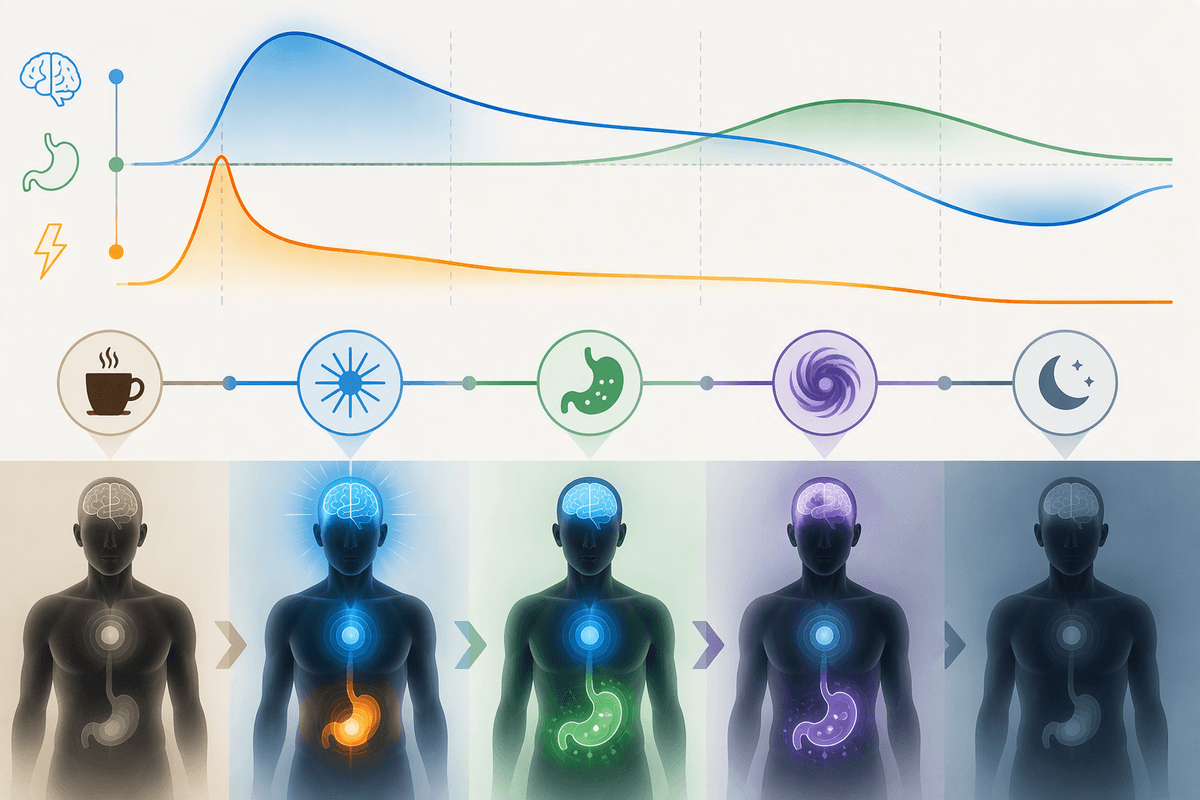
By the time you realize you haven’t eaten since breakfast, the signals can already be scrambled. A second cup of coffee can feel like it “solves” the slump, but sometimes what you notice first is a tight, alert edge—talking faster, tab‑hopping, a slightly clenched jaw—without the steady energy you expected. If lunch was skipped or pushed late, caffeine may land harder because there isn’t much else coming in, and the body can interpret that energizer hit as a reason to keep going.
Then the crash can arrive wearing a few different masks. Some people feel suddenly hungry, while others feel nauseated but still crave something sweet. You might blame the coffee itself, or assume you’re just dehydrated, because the timing isn’t consistent: a busy day with extra caffeine can delay the appetite cue, and a quiet day can make the same routine feel unbearable. It’s not always a clear “low blood sugar” moment—more a messy overlap of appetite, stress, and stimulation that’s easy to misread.
Why patterns intensify gradually over weeks
It’s usually not a single dramatic crash that convinces you something is off—it’s the way the dips start showing up more often. One week you only notice it after a pastry lunch. A couple weeks later, the same fuzzy irritability shows up after a “normal” sandwich, or even after a morning that felt fine. Because each day has different meetings, sleep, and stress, it can look random, like your body is changing its mind.
But repeated quick fixes tend to train the day into sharper edges: long gaps, a fast carb lift, a stronger drop, then a louder craving that nudges you back to the same solution. Poor sleep can make that swing feel steeper, and stress can keep you running on a tight, wired feeling until it suddenly falls away. Over time, the pattern may start earlier, last longer, and feel harder to talk yourself out of—less “a bad afternoon,” more a familiar loop.
Reading your own signals without overcorrecting
At some point you start watching yourself a little too closely: a yawn becomes “something’s wrong,” a sharp reply becomes “I’m crashing,” and every dip feels like it needs an immediate fix. But the body’s cues aren’t always clean labels. Fog can come from a real drop, from stress finally easing, or from caffeine wearing off at the exact wrong time. Hunger can show up as restlessness, or not show up at all until you’re suddenly short-tempered. That uncertainty is part of why it’s easy to reach for the fastest lever—sugar, another coffee, a quick snack—before you’ve figured out what signal you’re actually responding to.
What tends to help is noticing clusters instead of single moments: timing (how long since you ate), speed (how fast the mood shifts), and the “texture” of the feeling (hollow and urgent vs. wired and tight). If the same pattern repeats over a few afternoons, it becomes less of a personal failing and more like a readable rhythm—one you can adjust without swinging from restriction to rescue.


![14 Best Personal Finance Tips [Financial Planning Tips for 2026]](static/image/2026/08/19/386a0029-2149-472a-96de-933a87ee417e.jpeg)