Why Greece feels simple—until you start planning
The first time I tried to “quickly” sketch Greece, it looked almost too easy: a few days in Athens, pick one island, done. Then I opened the ferry schedules and realized the simple version only works if your dates, ports, and pace all line up—and they don’t always, especially in shoulder season.
Most first trips get tangled in the same trade-offs. You can have the postcard island or the easiest connections. You can keep costs midrange or stay walking-distance from everything. Ferries feel romantic until you’re staring at a 7:25 a.m. departure from a different port than you assumed, or a sea day that turns a “short hop” into a queasy half-day lost.
The good news: once you treat Greece like a set of connected choices (season, island, transport, neighborhood), the plan gets calmer—and you stop chasing an itinerary that only works on Instagram.
Best time to visit: weather, crowds, and costs
The first real planning fork is your calendar, because Greece behaves like two different trips depending on when you land. Summer (late June through August) is the “everything is open” version—but it’s also the “everything is booked” version, with heat in Athens that turns midday sightseeing into a shade-hunt and island nights that skew pricier even at midrange hotels.
For most first-timers trying to do Athens + one island without schedule stress, shoulder season is the sweet spot—with caveats. Late April to early June and September to mid-October usually give you better walking weather and saner prices, and you’re less likely to feel punished for choosing the “wrong” neighborhood or ferry class. Some beach clubs and tours run lighter schedules, and ferry frequency can drop fast once you slide into late October.
If you’re budget-sensitive, aim for May or late September: you still get a lively feel, but you’re less likely to pay peak rates for a room you’ll barely be in—and you won’t need to build your whole day around avoiding the sun.
How many days: Athens, islands, and pace
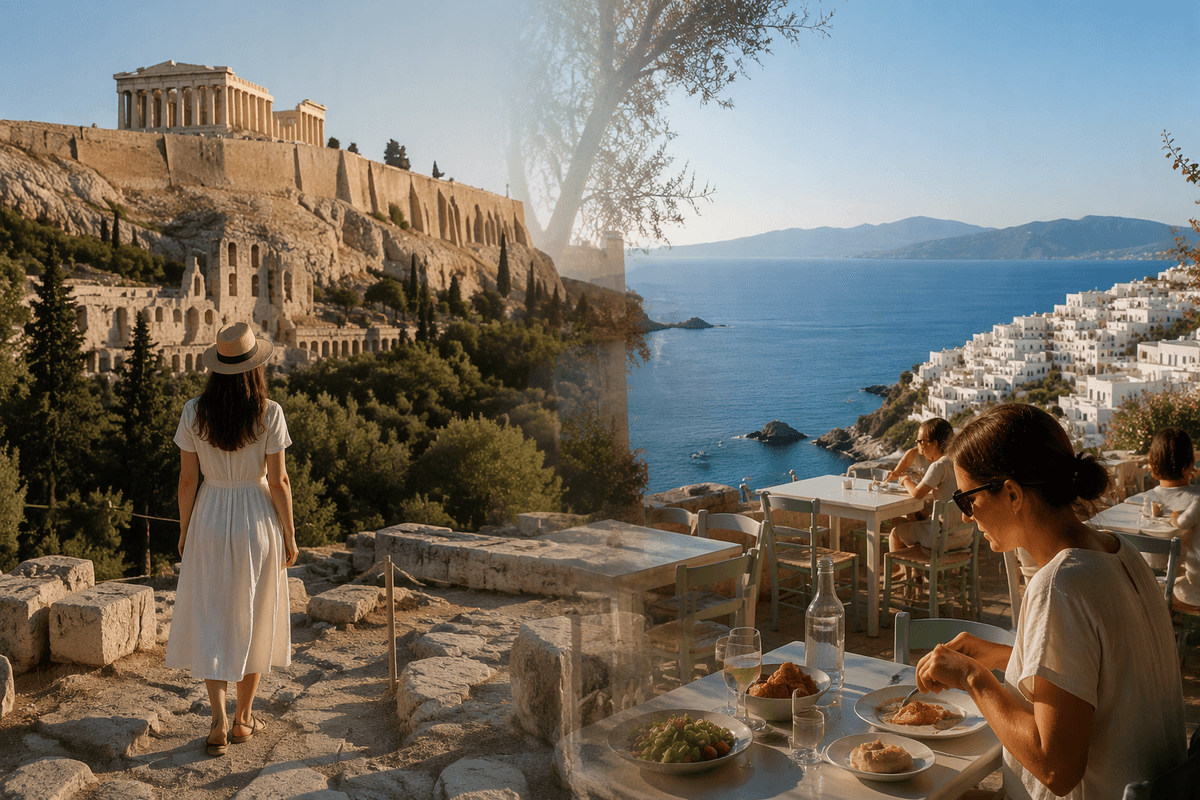
The first time I tried to force Greece into seven days, it wasn’t the sightseeing that broke the plan—it was the math of check-in/check-out plus transit time. A “quick” move to an island can quietly cost you half a day (getting to the right port, the ferry itself, then settling in), and that’s before you factor in a windy crossing or a schedule that only runs at awkward hours in shoulder season.
For a 7–10 day first trip, the least-regret split is usually 2–3 nights in Athens plus 4–6 nights on one island. Two nights in Athens works if you’re laser-focused (Acropolis early, one neighborhood wander, one museum), but it’s tight if your arrival is late or you want a slower food-and-streets pace. Three nights buys you a buffer for jet lag, a long lunch, and not doing the Acropolis in the heat of the day just because your schedule cornered you.
The island decision is really a pace decision. If you want easy logistics, pick one base and stay put—no island-hopping. If you want variety, accept the trade: two islands in 10 days can work, but only if the connection is direct and you’re okay spending a prime beach morning in transit (and possibly nauseous). When in doubt, add a night to your island rather than squeezing Athens, because moving accommodations is what makes Greece feel rushed.
Getting around: ferries, flights, cars, buses
The first time I tried to “just take the ferry,” I learned the hard way that Greece doesn’t have one ferry experience—it has several. The fast ferries feel like a clean time-saver on paper, but they’re pricier and can be bumpier in wind; the slower ones are gentler on the budget, yet they turn a travel day into a commitment. Either way, the hidden friction is the port: getting to Piraeus is usually straightforward, but some routes leave from other ports, and a “short hop” gets longer when you’re dragging luggage across Athens at rush hour.
For Athens + one island in 7–10 days, I default to a simple rule: if the island is close (think a few hours), ferry wins for door-to-door sanity; if it’s far, a flight can save an entire usable day. The trade-off is that flights add airport time and often a bag fee that creeps into your “midrange” budget.
On the island, cars are freedom until parking (and narrow roads) turns into a small daily tax. Buses are cheaper and surprisingly workable for popular beaches—just not on your schedule, especially in shoulder season when frequency drops. If you want low-stress, pick a base where you can walk to dinner and use buses or a couple of taxis for the outliers.
Money, tipping, and everyday costs
The moment my budget stopped feeling “midrange” was when I added up the little line items I’d been ignoring: a taxi to the port because the ferry was too early for the Metro, a second coffee because the first café was cash-only, and a beach setup that quietly cost as much as lunch. Greece can feel affordable day-to-day, but it’s also good at turning convenience into small, repeated upgrades.
In Athens and on most popular islands, cards work in the places you’ll naturally end up—hotels, sit-down restaurants, bigger shops—but I still carry cash for kiosks, bakeries, small tavernas, and anything that happens quickly (like a bottle of water when you’re already late). ATMs are easy to find, yet the friction is fees: use a bank ATM when you can, withdraw fewer times, and don’t be shy about declining any “helpful” exchange-rate conversion prompt.
Tipping is the part people overthink. You don’t need to tip like you’re in the U.S., but rounding up or leaving a few euros at a taverna (and a little more for genuinely attentive service) fits the rhythm. If you’re trying to keep costs steady, watch transport days and beach days—those are where “just this once” spending stacks up fastest.
What to pack: dress codes and beach basics

The packing mistake I see (and have made) is treating Greece like “endless beach” and forgetting how much walking Athens demands—and how quickly an island night gets breezy once the sun drops, especially in spring and fall. If you’re doing 7–10 days with one island base, pack for two modes: city pavement and salty, windy evenings.
For Athens, comfortable closed-toe shoes beat anything stylish you don’t want to climb in; the Acropolis’ slick stone is not the place to learn your sandals have no grip. I also like one light layer you can actually wear inside museums or on a ferry with aggressive A/C. For islands, bring a second swimsuit so you’re not stuck putting on a damp one, plus a quick-dry towel if your hotel beach setup is “bring your own.” The trade-off is space: skip heavy toiletries and pack a small pharmacy kit (motion sickness tabs, blister patches, sunscreen), because replacing those last-minute is easy but often overpriced near ports.
Dress codes are simpler than people fear: churches and monasteries are the main constraint—covered shoulders and longer shorts/skirts make entry painless. One nicer outfit is enough; the rest can be repeatable basics that survive heat, wind, and a surprise ferry delay.
Putting it together: confident choices without FOMO
The last decision that actually calms the whole trip is admitting you can’t “solve” Greece in 7–10 days—you can only pick the version with the least friction for your dates. When I stopped trying to add a second island “because everyone does,” the plan got instantly cleaner: fewer port transfers, fewer chances to miss a limited shoulder-season sailing, and more mornings that started with coffee instead of a checkout timer.
If you want a default that rarely backfires, build around two anchors: 3 nights in Athens (enough buffer for arrival, one big early Acropolis push, and a flexible neighborhood day) and 5–6 nights on one island you can reach in a straightforward way. Pay for convenience on the days that matter—an early taxi to the port, a slightly better ferry time, a hotel location that lets you walk to dinner—then be budget-strict on the parts that don’t (extra tours, “just in case” transfers, beach setups every day).
The practical takeaway: if a choice adds a connection, a port change, or a hard deadline, it’s not “more Greece,” it’s more ways to lose time. Pick one island you’re genuinely excited about, leave one open afternoon on both Athens and the island, and you’ll come home feeling like you traveled—rather than managed logistics.

![14 Best Personal Finance Tips [Financial Planning Tips for 2026]](static/image/2026/08/19/386a0029-2149-472a-96de-933a87ee417e.jpeg)